
How to Increase Your Vertical Jump by 6 Inches in 8 Weeks (Step-by-Step Program)
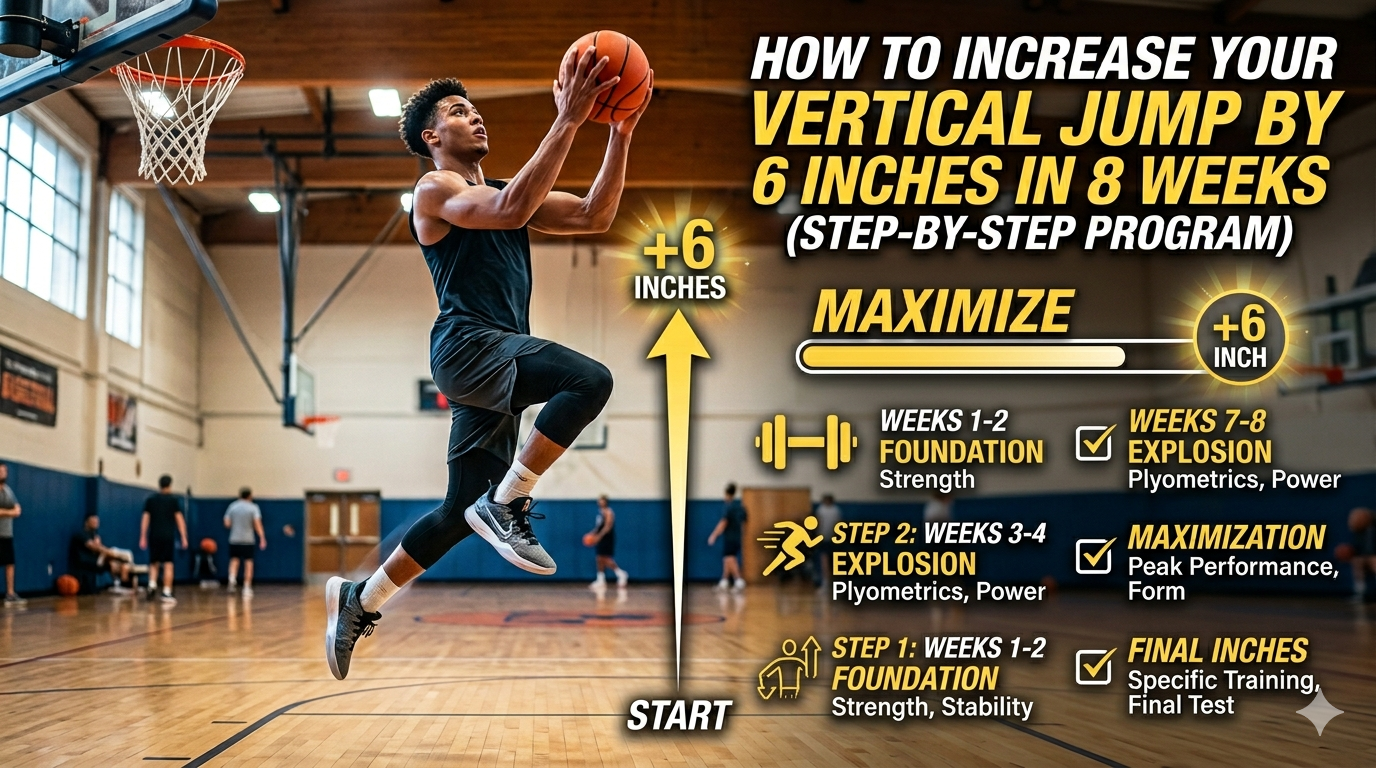
Disclaimer: This program is designed for intermediate athletes with a foundational level of strength (able to squat at least 1.2x bodyweight) and no current knee or back injuries. Adding 6 inches to your vertical in 8 weeks requires intense neuromuscular adaptation; proper nutrition, sleep (8+ hours), and warm-ups are non-negotiable.
The Science: Strength + Speed = Explosiveness
Vertical jump is a product of force production (strength) and force application (speed). To gain 6 inches, we cannot simply “jump a lot.” We must:
- Increase Max Strength: To move your body fast, you must be strong enough to apply massive force into the ground.
- Increase Rate of Force Development (RFD): How quickly you can produce that force (Plyometrics).
- Optimize Mechanics: Using your arms and stretch-shortening cycle efficiently.
Phase 1: Anatomical Adaptation & Strength (Weeks 1–2)
Goal: Prepare connective tissues for impact and build a strength base.
Schedule: 3 days per week (e.g., Monday, Wednesday, Friday)
Workout Structure
| Exercise | Sets | Reps | Notes |
| A. Barbell Back Squat | 4 | 6-8 | Focus on deep, controlled form. No bouncing. |
| B. Romanian Deadlift (RDL) | 3 | 8-10 | Hamstring focus. Keep a flat back. |
| C. Box Jumps | 4 | 4 | Step down from the box. Do not jump down. Focus on soft, quiet landing. |
| D. Dumbbell Step-ups | 3 | 6 (per leg) | Use a high box (knee at 90°). Explosive drive up. |
| E. Core (Pallof Press) | 3 | 10 (per side) | Anti-rotation to stabilize the torso during jumping. |
Rest: 2–3 minutes between sets A & B; 60-90 seconds for C, D, E.
Phase 2: Strength & Power Conversion (Weeks 3–5)
Goal: Increase absolute strength while introducing high-intensity plyometrics.
Schedule: 3 days per week (Monday, Wednesday, Friday)
Workout Structure
| Exercise | Sets | Reps | Notes |
| A. Trap Bar Deadlift | 4 | 4-5 | Safer than straight bar for athletes. Explosive on the way up. |
| B. Dumbbell Bulgarian Split Squat | 3 | 6 (per leg) | Rear foot elevated. This is crucial for unilateral stability. |
| C. Depth Jumps | 4 | 4 | Start on a 12-18 inch box. Step off, land softly, explode up instantly. Maximize ground contact time (<0.2 seconds). |
| D. Power Clean (or DB High Pull) | 4 | 3-5 | Olympic lifting teaches triple extension (ankles, knees, hips). |
| E. Weighted Plank | 3 | 45 sec | Add weight on back. |
Key Progression: Increase the weight on squats/deadlifts by 5–10 lbs weekly. For Depth Jumps, focus strictly on minimizing ground contact time (how long your feet touch the ground before jumping).
Phase 3: Peak Power & Supercompensation (Weeks 6–8)
Goal: Deload briefly, then peak neuromuscular efficiency for testing.
Schedule: 3 days per week, but Week 7 is a deload (reduce volume by 50%, keep intensity moderate).
Weeks 6 & 8 (Intense Weeks)
| Exercise | Sets | Reps | Notes |
| A. Hang Clean | 5 | 3 | Explosive triple extension. High velocity. |
| B. Anderson Squat (Pin Squat) | 4 | 3-5 | Start in the bottom position. This builds explosive starting strength. |
| C. Reactive Plyometrics | 4 | 5 | Alternating: Sprints (10-20 yards) and Max Vertical Jumps (full rest between jumps). |
| D. Nordic Curls | 3 | 8 | Hamstring strength prevents injury and aids in knee drive. |
| E. Calf Raises (Straight Leg) | 3 | 15 | Slow eccentric, explosive concentric. |
The “Secret Sauce”: The 3 Pillars of Execution
1. The “Zero-Volume” Jumping Rule
Do not practice your vertical jump with high volume. If you jump 50 times in a workout, you are teaching your nervous system to be slow and tired. For all 8 weeks:
- Max Effort Jumps: Only perform these fully rested (3–5 minutes rest) during the plyometric portions of your workout.
- Technique Jumps: If you are working on arm swing, do it at the beginning of the workout when the central nervous system (CNS) is fresh.
2. The Arm Swing (Adds 2–3 Inches Instantly)
Most athletes lose inches because of poor arm mechanics.
- The Load: As you dip, swing your arms back aggressively.
- The Drive: As you extend your legs, throw your arms forward and up violently.
- The Stop: Your arms should stop at eye level. Imagine trying to elbow someone standing behind you at the peak of your jump.
- Drill: Practice “Wall Jumps” (jumping straight up against a wall) focusing only on the arm swing rhythm for 2 minutes before every workout.
3. The Stretch-Shortening Cycle (SSC)
To jump high, you cannot do a “paused” squat before jumping. You must use an elastic rebound.
- The Dip: Keep your chest up. Dip by hinging at the hips and knees simultaneously.
- The Transition: Do not pause at the bottom. The moment you feel the stretch in your quads and glutes, reverse direction immediately. The shorter the time between the dip and the jump, the higher you will go.
Nutrition & Recovery Protocol
Without recovery, the CNS will burn out, and you will lose inches instead of gaining them.
- Sleep: 8–10 hours. Growth hormone (repair) peaks during sleep. This is non-negotiable.
- Hydration: Dehydration by just 2% decreases explosive power by up to 10%. Drink water with electrolytes.
- Protein: Aim for 1g of protein per pound of body weight to repair muscle fibers stressed by plyometrics.
- Creatine Monohydrate: 5g daily. This is the most researched supplement for repeated explosive output (ATP regeneration).
How to Test Your Vertical Jump
- Pre-Test (Day 1): Use a Vertec, chalk on a wall, or a wall with a measuring tape.
- Stand flat-footed, reach up, and mark your standing reach.
- Take a running start (if sport-specific) or a standing jump.
- Subtract standing reach from jump reach. Record average of 3 attempts.
- Mid-Test (End of Week 4): Test on a day you are fully rested (48 hours after last workout). Do not test after a leg day.
- Final Test (End of Week 8):
- Take 3 full days of rest (Active recovery: walking, light stretching).
- Perform a dynamic warm-up (leg swings, lunges, light jumps).
- Test your max. You should see a 4–6 inch improvement.
Troubleshooting: Why You Might Stall
| Problem | Likely Cause | Fix |
| Knees cave in during squat/jump | Weak glute medius | Add Banded Clamshells and Pigeon Stretch daily. |
| Feeling flat/heavy | CNS fatigue | You are doing too much volume. Skip one gym day and sleep. |
| Jump looks high but feels slow | Lack of elasticity | Focus on Depth Jumps with minimal ground contact. |
| Lower back pain | Weak core or poor bracing | Stop deadlifting for a week. Focus on Stir the Pot core exercises. |
Final Checklist for 8 Weeks
- Video yourself jumping weekly to analyze arm swing and knee stability.
- Warm up: 10 minutes of dynamic stretching + glute activation (banded walks) before every workout. Never static stretch cold muscles.
- Track your lifts: If your squat or deadlift max hasn’t gone up by Week 4, you likely won’t hit your jump goal. Strength is the engine.
- Stop if you feel shin splints or patellar tendon pain. Plyometrics on injured tendons leads to tendinopathy. Switch to swimming/biking until pain free.
Commit to the process. The nervous system adapts slowly. By Week 6, you may feel like you haven’t improved; this is normal during the accumulation phase. The “peaking” happens in Weeks 7 and 8. Trust the strength gains, respect the plyometrics, and sleep.